Golden Triangle with Mumbai – Explore the Best of India Golden Triangle Tour
- Duration: 7 Days, 6 Nights
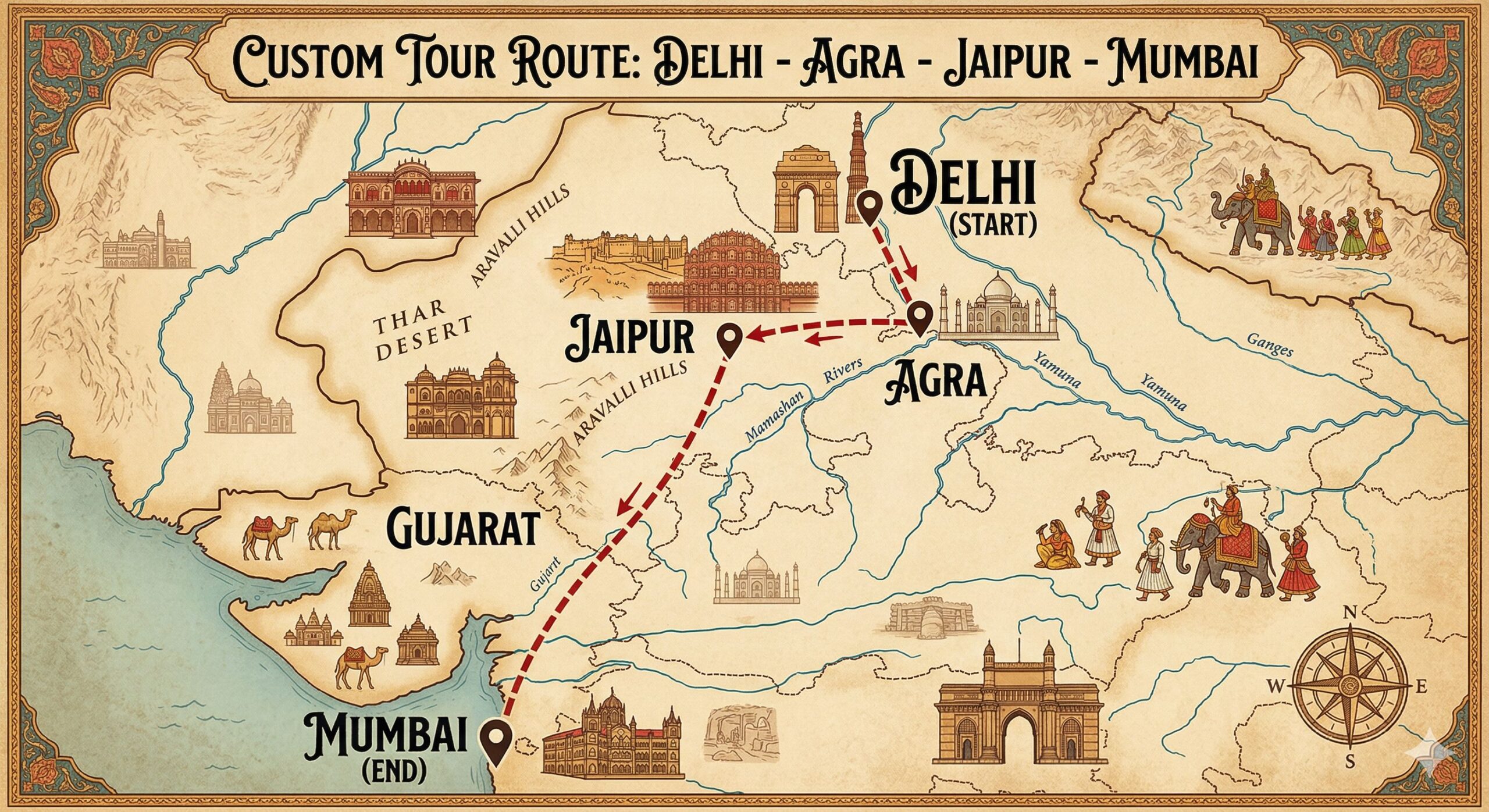
- Itinerary: Delhi – Agra – Jaipur – Mumbai
 Exclusive Private Tours (2–12 Travelers)
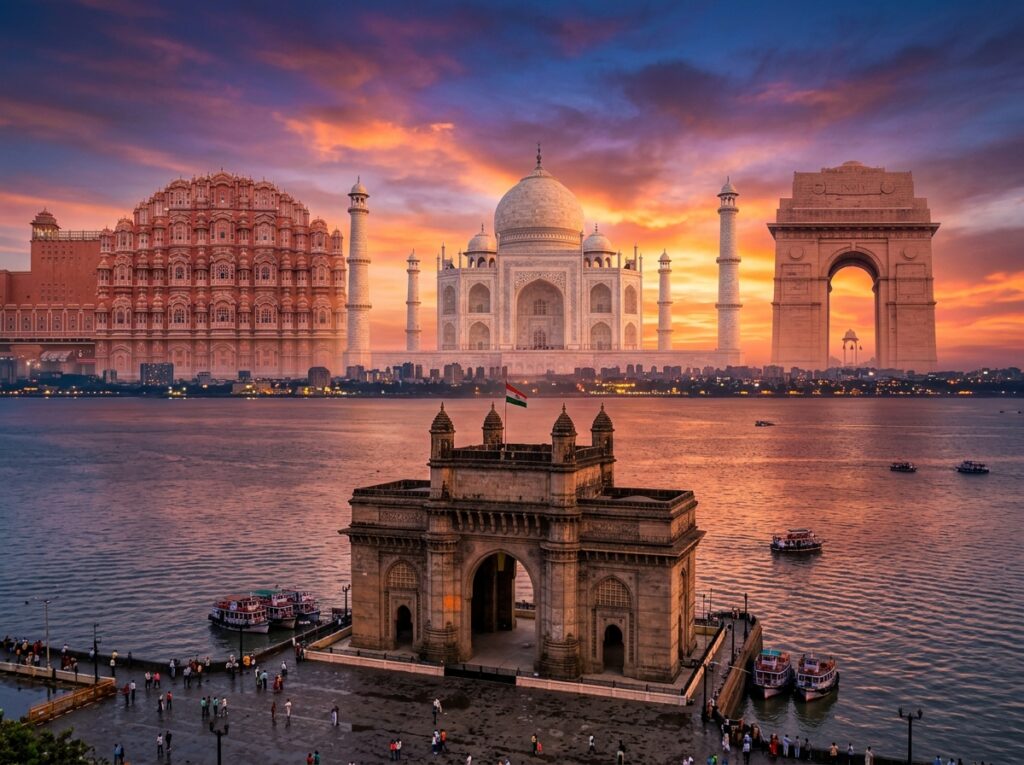
Experience the essence of India with our thoughtfully curated Golden Triangle Tour, now including vibrant Mumbai. Designed for intimate groups, this journey combines Delhi’s charm, Agra’s wonders, Jaipur’s royal heritage and Mumbai’s coastal energy. Enjoy a seamless blend of comfort, culture and authenticity on this iconic route.
 Upcoming Travel Dates
- 21 September 2026 – 27 September 2026 A perfect introduction to India’s Golden Triangle with a coastal twist in Mumbai.
- 15 October 2026 – 21 October 2026 Celebrate festive vibes while exploring India’s historic and modern treasures.
- 08 November 2026 – 14 November 2026 Enjoy the best weather season to discover India’s diversity and beauty.
- 03 December 2026 – 09 December 2026 A winter special combining Mughal grandeur and modern charm.
- 11 January 2027 – 17 January 2027 Begin the new year with India’s top destinations and cultural richness.
- 02 February 2027 – 08 February 2027 Royal palaces, timeless traditions and coastal delights in one journey.
| UNIT | NETT PER PERSON RATES (USD) | SINGLE ROOM SUPP. (USD) |
|---|---|---|
| At least 2 paying pax double/twin sharing |
2175 USD | 685 USD |
| At least 4 paying pax double/twin sharing |
1950 USD | 685 USD |
| At least 6 paying pax double/twin sharing |
1800 USD | 685 USD |
| At least 8 paying pax double/twin sharing |
1675 USD | 685 USD |
| At least 10 paying pax double/twin sharing |
1575 USD | 685 USD |
| At least 12 paying pax double/twin sharing |
1495 USD | 685 USD |
| CITY | HOTELS | NO. OF NIGHTS |
|---|---|---|
| Delhi | Vivanta By Taj | 2 |
| Agra | Clarks Shiraz | 1 |
| Jaipur | Golden Tulip | 2 |
Mumbai | Hotel President | 2 |
*or similar category Hotels.
IMPORTANT:
- Kindly note that the names of hotels mentioned above only indicate that our rates have been based on the usage of these hotels and it is not to be construed that accommodation is confirmed at these hotels until and unless we convey such confirmation to you. In the event of accommodation not becoming available at any of the above-mentioned hotels, we shall book alternate accommodation at a similar or next best available hotel and shall pass on the difference of rates (supplement/reduction whatever is applicable) to you.
- Our offer is based on usage of base category rooms at the mentioned hotels (unless specified otherwise) and if this category of rooms is not available we shall try to confirm accommodation in the next available higher category of rooms and shall advise the supplementary cost involved while conveying the status.
- Airfare for domestic flights may vary at the time of actual booking. The difference in rates (supplement/reduction whatever is applicable) will be updated for you.
ITINERARY
Arrive Delhi - On arrival, you will be greeted and assisted by our representative and transferred to the Hotel. (Check-in time 1400 hrs)
DELHI - It is a city that bridges two different worlds. Old Delhi, once the capital of Islamic India, is a labyrinth of narrow lanes lined with crumbling havelis and formidable mosques. In contrast, the imperial city of New Delhi created by the British Raj is composed of spacious, tree-lined avenues and imposing government buildings.
Delhi has been the seat of power for several rulers and many empires for about a millennium. Many a times the city was built, destroyed and then rebuilt here. Interestingly, a number of Delhi's rulers played a dual role, first as destroyers and then as creators.
Overnight rest at the Hotel in Delhi.
After breakfast, proceed for visit of Delhi including following:
Heritage Walk in Old City
Old Delhi Bazaars have colourful and interesting street food and is crowned with the oldest shops with many delicacies. You may enjoy a visual treat. The area is also home to several small temples, shrines, old mosque and protected monument sight. Cows wander the streets, small dharamshalas (rest-houses) and pyaus (water-stations) attest to the pious contributions of local merchants.
The walk is an escorted experience in English for about 3-3.5 delightful hours as we explore the galis (bye lanes) of Shahjahanabad (Old City), the city built by Emperor Shah Jahan(1628-1658).
Raj Ghat
Raj Ghat is a memorial to Mahatma Gandhi. It is a black marble platform that marks the spot of Mahatma Gandhi's cremation, on 31 January 1948, a day after his assassination. It is left open to the sky while an eternal flame burns perpetually at one end. It is located on the banks of the river Yamuna in Delhi on Ring Road officially known as Mahatma Gandhi Road. A stone footpath flanked by lawns leads to the walled enclosure that houses the memorial.
Drive past the Govt. Buildings
New Delhi houses several government buildings and official residences reminiscent of the British colonial architecture. Today we will drive past few of them, like The Parliament House, designed by Baker is 173m in diameter, the Rashtrapati Bhawan once the Viceroy’s residence is now the official residence of the President of India. Designed by Lutyens, it combines western and eastern styles.
Photo stop at the India Gate
At the centre of New Delhi stands the 42 m high India Gate, an "Arc-de-Triumph" like archway in the middle of a crossroad. Almost similar to its French counterpart, it commemorates the 70,000 Indian soldiers who lost their lives fighting for the British Army during the World War I. The memorial bears the names of more than 13,516 British and Indian soldiers killed in the Northwestern Frontier in the Afghan war of 1919. Under the arch, the Amar Jawan Jyoti commemorating Indian armed forces’ losses in the Indo-Pakistan war of 1971.
Gurudwara Bangla Sahib
Bangla Sahib Gurudwara is a Sikh temple located in Delhi. It is named after the 8th Sikh Guru, Guru Harkishan Singh, and is one of the most important places of worship for the Sikh community in Delhi.
The temple is well known for its Langar Hall (community kitchen), which serves free meals to all visitors, regardless of religion. Food is served twice a day, and around 8,000–10,000 people eat here daily.
Qutub Minar
Qutub Minar is a soaring, 73 m-high tower of victory, built in 1193 by Qutab-ud-din Aibak. The tower has five distinct storey’s, each marked by a projecting balcony and tapers from a 15 m diameter at the base to just 2.5 m at the top. The first three storeys are made of red sandstone; the fourth and fifth storey’s are of marble and sandstone. At the foot of the tower is the Quwwat-ul-Islam Mosque, the first mosque to be built in India. A 7 m-high iron pillar stands in the courtyard of the mosque. It is said that if you can encircle it with your hands while standing with your back to it your wish will be fulfilled.
Overnight at the hotel in Delhi.
After breakfast, drive to Agra.
AGRA - The city of the inimitable “TAJ MAHAL”.
The architectural splendour of the mausoleums, the fort and the palaces is vivid reminder of the opulence of the legendary Mughal Empire. While its significance as a political center ended with the transfer of the capital to Delhi in 1634 by Shah Jahan, its architectural wealth has secured its place on the international map. A pleasant town with a comparatively slow pace, Agra is known for its superb inlay work on marble and soapstone by craftsmen who are descendants of those who worked under the Mughals.
Visit the following in Agra :
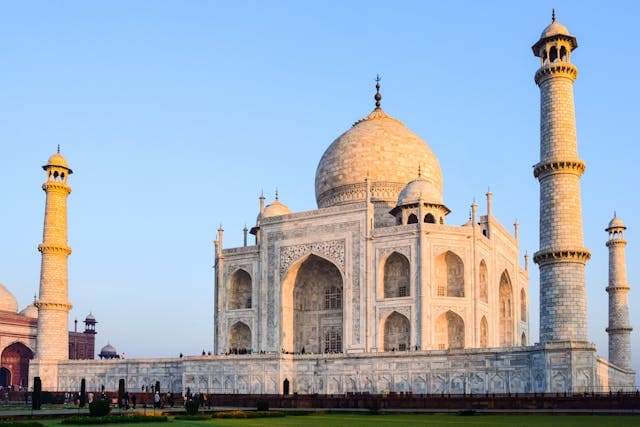
Taj Mahal
Taj Mahal or Crown of Palaces is a white marble mausoleum, built by Mughal Emperor Shahjahan as a memorial to his beloved wife Mumtaz Mahal. A world-renowned wonder, Taj Mahal looks the same from all the four sides and is widely recognized as "the jewel of Muslim art in India and one of the universally admired masterpieces of the world's heritage". The Taj Mahal is phenomenal not in the beauty alone but in the deep planning and design that went into its making. This enchanting mausoleum started in 1631 and it took 22 years to complete with the help of an estimated 20000 workers. (It remains closed on Fridays).
Agra Fort
The great Mughal Emperor Akbar commissioned the construction of the Agra Fort although additions were made till the time of his grandson Shahjahan. The forbidding exteriors of this fort hide an inner paradise. There are a number of exquisite buildings like Moti Masjid - a white marble mosque akin to a perfect pearl; Diwan-I-Am, Diwan-I-Khaas, Musamman Burj - where Shahjahan died in 1666 A.D. Jahangir's Palace; Khaas Mahal and Shish Mahal. The massive Agra fort is 2.5 km long and is considered as the predecessor of the Delhi Red fort.
Itimad –Ud-Daulah
Sometimes called the ‘Baby Taj’ because of its resemblance to Agra’s most famous monument. However Itimad-ud-Daulah’s Tomb was built before the Taj Mahal. A number of its stylistic features, such as a Tomb in white marble surrounded by a formal garden and the use of inlaywork in the marble to create floral or geometric designs, inspired similar features of the Taj Mahal
Mehtab Bagh
Mehtab Bagh is a garden Complex just located on the opposite side of the Yamuna River. One of the best place in Agra to enjoy the sunset with the rear view of Taj Mahal.
Overnight at the hotel in Agra.
After breakfast, drive to Jaipur enroute visiting Abhaneri.
Abhaneri
On the way to Jaipur, visit the village of Abhaneri. Abhaneri is a small village with a population of approximately 2,000 people. The village is known for Chand Baori Stepwell. Stepwells were very important in the past. The purpose was to collect the Rainwater. Stepwell Chand Baori is the largest in India.
Later proceed to Jaipur.
JAIPUR - The fascinating capital of the marvellous state of Rajasthan.
Jaipur is popularly known as the Pink City, thanks to the colour of its buildings. It was built in 1727 A.D by Maharaja Sawai Jai Singh II, followed a grid system, which made it the only planned city of its time. A young Bengali architect Vidhyadhar Bhattacharya designed the city in accordance with Shilpa Shastra - an ancient Hindu treatise on architecture. There are innumerable sagas and stories of culture, traditions, practices and valour. This diverse land of rich cultural heritage is a royal treat for tourists all over the world.
On arrival in Jaipur, transfer to hotel.
In the evening enjoy Aarti Ceremony at Birla Temple.
The Lakshmi - Narayan Temple known as Birla Mandir is situated just below the Moti Dungari. This is a modern temple built of white marble on top of a hill, dominating the skyline of south Jaipur. The Birlas (industrialists who have also built several temples in India) built this temple. The temple has been constructed in white marble. The presiding deities here are Vishnu (One of the Hindu Trinity Gods) called Narayan and his consort Lakshmi, Goddess of wealth and good fortune.
Overnight at the hotel in Jaipur.
After breakfast, city tour in Jaipur including following :
Amber Fort
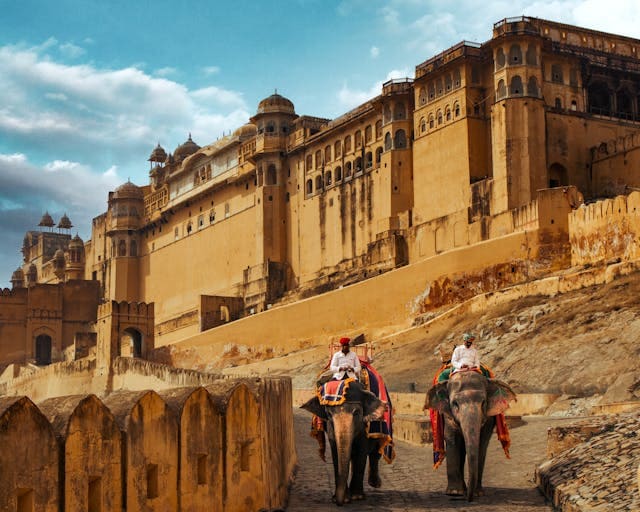
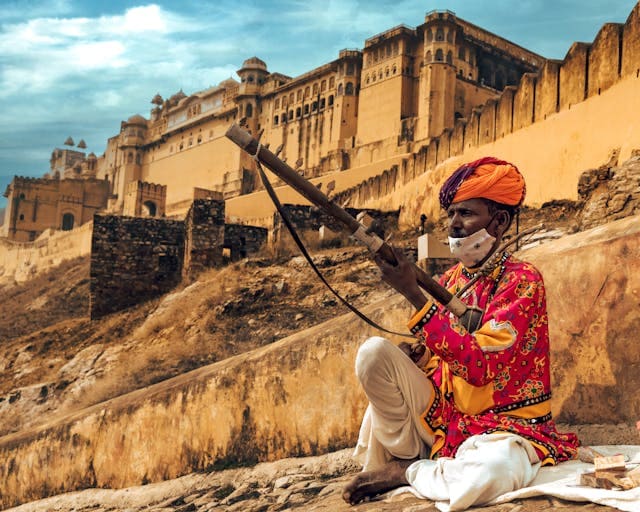
The Amber Fort set in picturesque and rugged hills is a fascinating blend of Hindu and Mughal architecture. Constructed by Raja Man Singh I in 1592 and completed by Mirja Raja Jai Singh, the fort was made in red sand stone and white marble. Amber is the classic and romantic fort-palace with a magnificent aura. The interior wall of the palace depicts expressive painting scenes with carvings, precious stones and mirror settings. Built mainly for the warring enemies as a safe place, the heavily structured walls could defend the residents within the ramparts of the fort.
Photo stop at the Hawa Mahal Palace
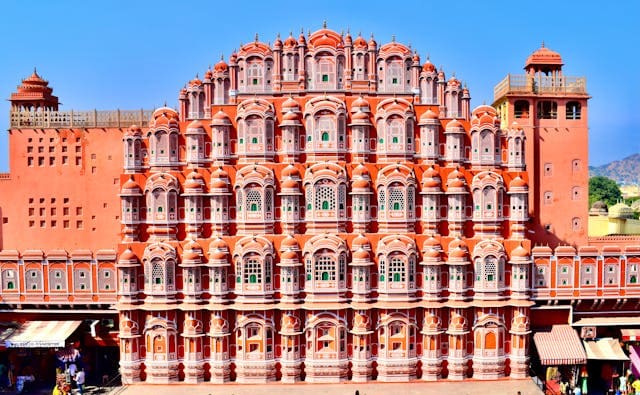
The poet king Sawai Pratap Singh built this palace of winds. This is easily the most well-known landmarks of Jaipur and is also its icon. This five-storey building overlooking the busy bazaar street is a fascinating example of Rajput architecture and artistry with its delicately honeycombed 953 pink sandstone windows known as 'jharokhas'. It was originally built for the ladies of the royal household to watch everyday life and processions in the city from their veiled comfort.
City Palace
Located in the heart of the walled city, the City Palace Complex gives you an idea about the farsightedness of the founder of Jaipur Maharaja Sawai Jai Singh. He left behind a legacy of some of the ‘most imposing and magnificent architecture in the city. Maharaja Sawai Jai Singh built many buildings but some of the structures were also built by later rulers. The palace is a blend of Mughal and Rajput architecture and the ex-royal family still lives in a part of the palace.
Jantar Mantar
The Jantar Mantar is a collection of architectural astronomical instruments, built by Maharaja (King) Jai Singh II between 1727 and 1734. It is modeled after the one that he had built for him at Delhi. He had constructed a total of five such facilities at different locations, including the ones at Delhi and Jaipur. The Jaipur observatory is the largest and best preserved of these. It has been inscribed on the World Heritage List as "an expression of the astronomical skills and cosmological concepts of the court of a scholarly prince at the end of the Mughal period".
Later in the afternoon, enjoy a Rickshaw ride in the old City and explore the local markets of Jaipur.
Optional: Elephant bathing, feeding, painting, safari with BBQ Dinner at Dera Amer (90 USD per person, drinks extra)
It is a kind of activity with Elephants which is quite special and we are sure you would not have seen anything like this before. It is the experience of owning a beautiful creature like elephant for a day. This evening will be full of adventure with these beautiful & magnificent creatures, it is a special chance for you to get close and become friends with elephants and interact with it for real. In our paintings we use organic colours. All our elephants are female elephants which also makes them loving and gentle and no aggression towards guests who feed them, play with them or bathe them.
Overnight at the hotel in Jaipur.
In time transfer to Airport to board flight for Mumbai.
Upon arrival meet, assist and transfer to Hotel.
MUMBAI – The city that never sleeps! Pulsating, Alive, On the Move, Vibrant, Fun -- this is Mumbai or as it is still frequently referred to -- Bombay. The most modern city in India, it captures the spirit of the changing pace set by liberalization and modernization. It is better known as Economic Capital of India.
Once a cluster of seven islands, Mumbai was presented to King Charles II in 1661 as part of the dowry when he married Princess Catherine de Braganza of Portugal.
Later in the afternoon proceed for half day city tour in Mumbai :
Gateway of India
Gateway of India designed by Scotland-born architect, George Wittet. Sporting exquisite Mughal-style design elements, this imposing basalt arch overlooks the Mumbai Harbor.
Hanging Garden
Perched at the top of Malabar Hill, on its western side, just opposite the Kamala Nehru Park, these terraced gardens; also known as Ferozeshah Mehta Gardens, provide lovely sunset views over the Arabian Sea. The park was laid out in the early 1880s over Bombay's main reservoir, some say to cover the water from the potentially contaminating activity of the nearby Towers of Silence.
Mani Bhawan
A memorial dedicated to the Father of the Nation, Mahatma Gandhi. He used to stay at House No.19 called Man Bhavan, from time to time between 1917 and 1934. He was arrested here in 1932 and taken off for one of his many prison terms. The building now contains a pictorial gallery, a 20,000-volume research library, a film and recording archive and a set of diorama on the Mahatma's life.
Marine drive
Built in 1920, Marine Drive runs along the shoreline of the Arabian Sea from Nariman Point to the foot of Malabar Hill. It passes Chowpatty Beach along the way. It's one of Mumbai's most popular romantic spot and sunset view is amazing. Tourist brochures are fond of stating it as the Queen's Necklace, because of the dramatic curve of its streetlights at night.
Tower of Silence
A peculiar site to visit in Mumbai is the Tower of Silence. Mumbai has a large number of Parsi populations. The Parsis have the custom of leaving their dead in the open. These particular places are called "Towers of Silence", where the vultures come to eat the dead. For the Parsis, this is regarded as the final act of charity. Mumbai's Towers of Silence have virtually disappeared today. Only a handful remains that attract a considerable number of tourists every year.
Overnight at the hotel in Mumbai.
After breakfast, visit the following in Mumbai:
Photo stop at Dhobi Ghat
A unique feature of Mumbai, the dhobi is a traditional laundryman, who will collect your dirty linen, wash it, and return it neatly pressed to your doorstep. The "laundries" are called "ghats": row upon row of concrete wash pens, each fitted with its own flogging stone. The clothes are soaked in sudsy water, thrashed on the flogging stones, then tossed into huge vats of boiling starch and hung out to dry. Next they are ironed and piled into neat bundles.
Dabba-Wallahs
Enjoy some time watching the dabba-wallahs, the members of the Mumbai Tiffin Box Suppliers Association. Every day 4,000 of them deliver fresh, home-cooked food from 100,000 suburban kitchens to offices in the downtown area. Each lunch is prepared by a loving wife or mother, and packed into a set of stackable aluminium boxes. The meals are carried to their hungry recipients dangling from shoulder-poles and bicycle handlebars, and stacked on decorated handcarts. Tins are rarely, if ever, lost, and always find their way home again to be washed up for the next day’s lunch. (Dabba-Wallahs are closed on public holidays and weekends)
Victoria Terminus
Have a photo stop at the remarkable Victoria Terminus. It was built during Queen Victoria's Golden Jubilee year. It is an extraordinary conglomeration of domes, spires, Corinthian columns and minarets in a style described by journalist James Cameron as “Victorian-Gothic-Saracenic-Italianate-Oriental-St. Pancras-Baroque.” The first train in India left from this station in 1853; today half a million commuters uses the station every day.
Slum Tour
Enjoy Dharavi slums tour and see why it is the heart of small scale industry in Mumbai – Known to many as ‘one of the largest slums in Asia’, we prefer to think of Dharavi as Mumbai’s beating heart. It houses about one million of Mumbai’s inhabitants and its industries have an annual turnover of approximately US$ 665 million. Through our educational walking tours, visitors experience a wide range of these business activities: recycling, pottery-making, embroidery, bakery, soap factory, leather tanning, poppadom - making and many more.
We’ll also visit the residential areas of Dharavi. People from all over India have come to live in Dharavi, making it a microcosm of India. This diversity is apparent in the temples, mosques, churches and pagodas that stand side by side.
Prince of Wales Musuem
Prince of Wales Museum is the erstwhile name of Chhatrapati Shivaji Maharaj Vastu Sangrahalaya of Mumbai. In 1905, George V laid down, the Prince of Wales himself, who came on a visit to India its foundation stone. George Wittet, an architect, designed the splendid structure. The construction work was concluded in 1914, but Lady Lloyd inaugurated the full-fledged museum in 1923. Art, Archaeology and Natural History are three exclusive sections in the museum. It houses some of finest collections, ranging from ancient Indus Valley relics to the artefacts from the Gupta and Maurya Periods. IMP: Prince of Wales Museum is closed on Monday.
Later on time Check out from Hotel and transfer to the airport to board flight for back home.
End of Services
Services included:
- Services of an accompanying Tour Guide from arrival to departure
- All ground transportation as detailed in the itinerary using air-conditioned vehicles
- Double/Twin occupancy Room with breakfast
- Monument entrance fees mentioned in the Tour Itinerary
- Domestic Airfare from Jaipur to Mumbai
- City tour in Mumbai
- Slum Tour in Mumbai
- Water bottles during the Tour
- Currently applicable Taxes
Not included services:
- Visa application process and fees
- International airfares & taxes
- Camera and Video charges at the monuments where applicable
- Any expenditure of a personal nature such as drinks, tips, laundry, telephone charges, etc
- Insurances (travel cancellation insurance, health insurance, etc)
- Any new tax imposed by the government
- Any chosen optional activity / Program
Highlights Of The Trip
- Visit to the UNESCO World Heritage Site & One of the 7 wonders of the World, Taj Mahal
- Visit the UNESCO World Heritage Site, Qutub Minar in Delhi
- Visit to the UNESCO World Heritage Site, Agra Fort in Agra
- Visit to the World Heritage Site, Jaipur
- Visit to the Bangla Sahib Sikh Temple in Delhi
- Visit an around 1000-year-old Stepwell in Abhaneri
- Slum Tour in Mumbai
GALLERY / PHOTOS


BOOK A CALL BACK WITH AGENT TODAY
MORE PACKAGES
OTHER TRAVEL PACKAGES
Embark on a remarkable journey through Golden Triangle India — covering Delhi, Agra, Jaipur and Mumbai.
This India Golden Triangle Package is a perfect blend of cultural heritage, royal architecture and modern Indian lifestyle.
Start from Delhi, where history meets modern vibrance. Continue to Agra to witness the timeless beauty of the Taj Mahal, one of the Seven Wonders of the World. Move on to Jaipur, the Pink City, filled with majestic forts, royal palaces, and colorful markets. End your journey in Mumbai, the financial and entertainment capital of India, where colonial charm and coastal life come together beautifully.
Whether you’re a first-time traveler or an explorer of Indian culture, this Golden Triangle Tour with Mumbai offers an unforgettable experience of art, history and lifestyle — all in one trip.
Golden Triangle Tour Overview
Frequently Asked Questions: Golden Triangle with Mumbai Tour
1. What is included in the Golden Triangle with Mumbai tour?
This journey typically includes Delhi, Agra and Jaipur—known as India’s Golden Triangle—combined with Mumbai, India’s most dynamic city. Travelers experience iconic landmarks like the Taj Mahal, historic forts and palaces and the vibrant culture, food and lifestyle of Mumbai.
2. How many days are ideal for the Golden Triangle with Mumbai tour?
A well-paced itinerary usually takes 07 to 10 days, allowing you to explore each destination comfortably while also experiencing local culture, heritage and everyday life.
3. What is the best time to visit Delhi, Agra, Jaipur and Mumbai?
The best time to travel is between October and March, when the weather is pleasant across North India and Mumbai. This period is ideal for sightseeing, cultural experiences and comfortable travel.
4. Is the Golden Triangle with Mumbai tour suitable for first-time visitors to India?
Yes, this is one of the best routes for first-time travelers. It offers a perfect introduction to India’s history, culture, architecture and modern life—combining iconic highlights with diverse experiences.
5. Can this tour be customized based on my preferences?
Absolutely. The Golden Triangle with Mumbai tour can be fully customized based on your interests, travel pace, accommodation preferences and specific experiences you would like to include.
6. What type of accommodation is provided during the tour?
Depending on your preference, accommodations range from boutique hotels and heritage properties to premium and luxury stays—carefully selected to enhance your overall travel experience.
7. How do you travel between the cities on this tour?
Travel is typically arranged through a combination of private chauffeur-driven vehicles for Delhi, Agra and Jaipur, along with domestic flights or trains to Mumbai—ensuring comfort and efficiency.
8. Is Mumbai very different from the Golden Triangle cities?
Yes, Mumbai offers a completely different perspective of India. While the Golden Triangle focuses on history and heritage, Mumbai showcases modern India—its energy, diversity, colonial architecture, and vibrant street life.
9. Is India safe for international travelers on this route?
Yes, the Golden Triangle and Mumbai are among the most visited regions in India. With proper planning, local guidance and curated experiences, travelers can explore comfortably and safely.
10. What experiences can I expect beyond sightseeing?
Beyond monuments, you can enjoy local markets, cultural interactions, heritage walks, food experiences and everyday moments that offer a deeper understanding of India.
11. Do I need a visa to travel to India?
Yes, most international travelers require a visa to visit India. The e-visa process is simple and can be completed online before your journey.
12. Can this tour be combined with other destinations in India?
Yes, this itinerary can easily be extended to include destinations like Varanasi, Udaipur, Kerala or Goa for a more diverse India travel experience.
Book Your Golden Triangle Tour Now
Discover the magic of India Golden Triangle with an added touch of Mumbai’s modern spirit.
From Delhi’s Mughal wonders to Jaipur’s royal heritage and the timeless Taj Mahal in Agra — this Golden Triangle Tour lets you experience India’s soul in style.
Book Your India Golden Triangle Package Today!
Experience luxury, culture and color in one unforgettable journey across India’s most iconic cities.