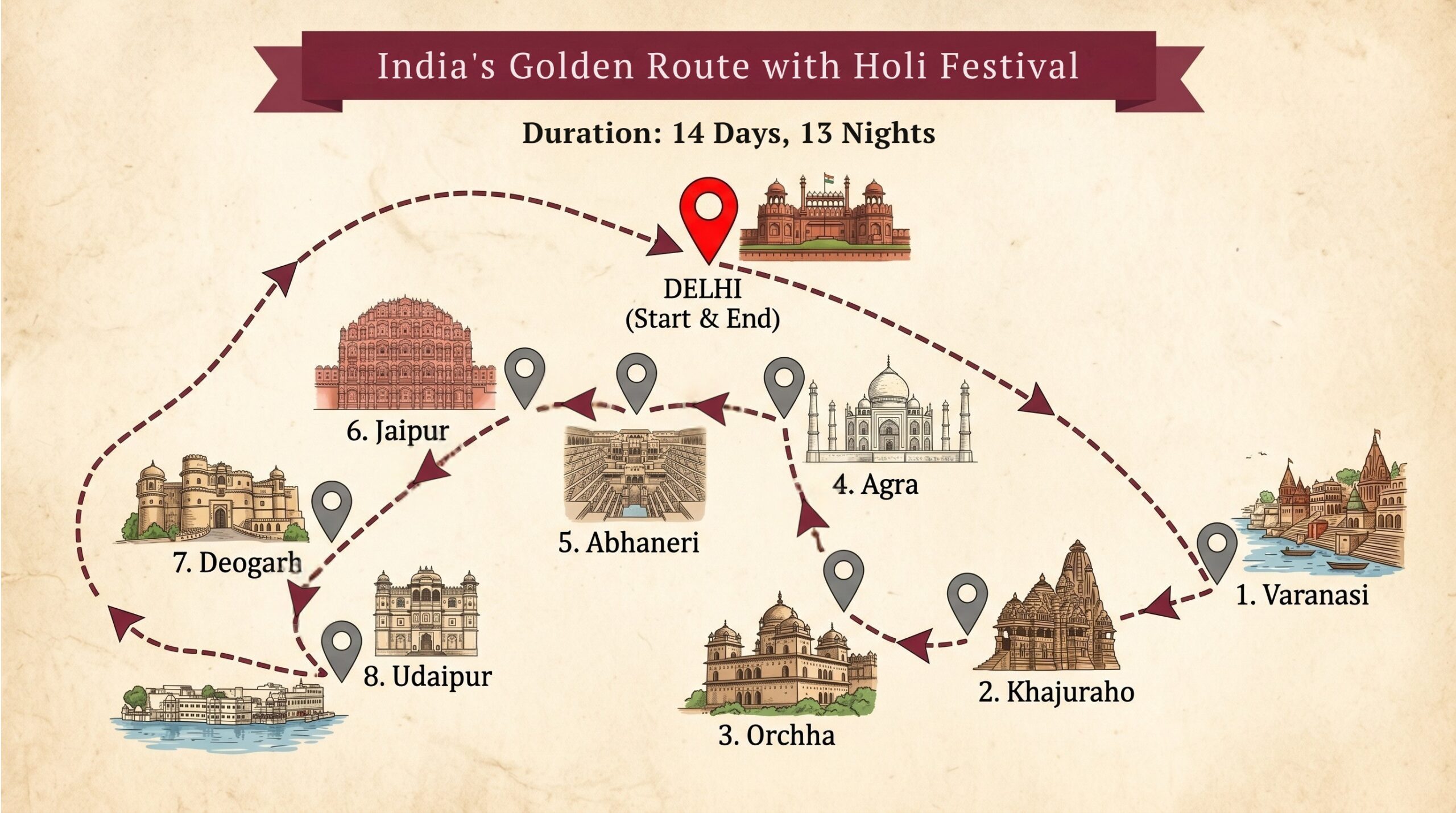
India's Golden Route with Holi Festival
Holi & Heritage: A 14-Day Celebration Across India’s Iconic Landmarks
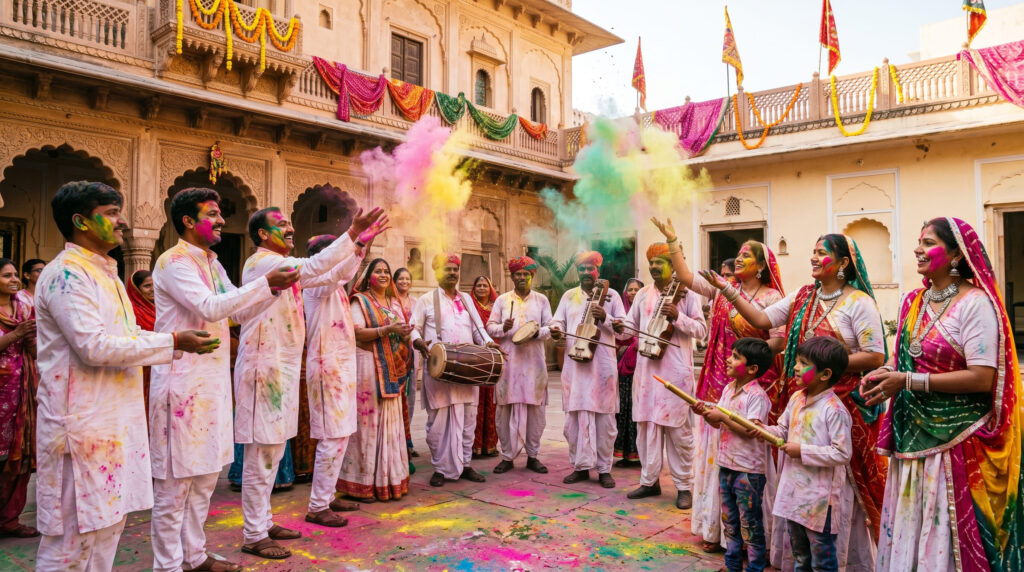
- Duration: 14 Days, 13 Nights
- Itinerary: Delhi – Varanasi – Khajuraho – Orchha – Agra – Abhaneri – Jaipur – Deogarh – Udaipur – Delhi.
🌟 Small Group Travel Itinerary: From the Ganges to the Taj 🌟
Embark on a two-week exploration through India, filled with history, culture, and the vibrant celebration of Holi. This intimate journey takes you through iconic destinations, offering an authentic experience that blends tradition, beauty, and festivities.
📅 Upcoming Travel Dates 📅
-
13 March – 26 March 2027
Join us for a celebration of color, culture, and heritage, culminating in the unforgettable Holi Festival experience.
| UNIT | NETT PER PERSON RATES (USD) | SINGLE ROOM SUPP. (USD) |
|---|---|---|
| At least 6 paying pax double/twin sharing |
3150 USD | 1250 USD |
| At least 8 paying pax double/twin sharing |
2815 USD | 1250 USD |
| At least 10 paying pax double/twin sharing |
2650 USD | 1250 USD |
| At least 12 paying pax double/twin sharing |
2545 USD | 1250 USD |
| CITY | HOTELS | NO. OF NIGHTS |
|---|---|---|
| Delhi | Vivanta by Taj | 2 |
| Varanasi | Hotel Madin | 2 |
| Khajuraho | Hotel Ramada | 1 |
| Orchha | Amar Mahal | 1 |
| Agra | Hotel Clarks Shiraz | 1 |
| Jaipur | Hotel Golden Tulip | 3 |
| Deogarh | Deogarh Mahal | 1 |
| Udaipur | Fateh Niwas | 2 |
| Delhi | Vivanta by Taj | Freshen Up Room with Dinner |
*or similar category Hotels.
Check-in / out time is 12 noon at all the hotels, except Delhi (Check-in: 1400 hrs, Check-out: 12 noon).
Total Number of Night/s: 13 Nights & Freshen Up Room with Dinner
IMPORTANT:
- Kindly note that names of hotels mentioned above only indicate that our rates have been based on usage of these hotels and it is not to be construed that accommodation is confirmed at these hotels until and unless we convey such confirmation to you. In the event of accommodation not becoming available at any of the above-mentioned hotels we shall book alternate accommodation at a similar or next best available hotel and shall pass on the difference of rates (supplement/reduction whatever applicable) to you.
- Our offer is based on usage of base category rooms at the mentioned hotels (unless specified otherwise) and if this category of rooms is not available we shall try to confirm accommodation in next available higher category of rooms and shall advise supplementary cost involved while conveying the status.
- Airfare is based on current pricing and remains subject to change until ticket issuance. Any fare difference (increase or decrease) will be advised accordingly.
ITINERARY
Arrive in Delhi.
On arrival, you will be greeted and assisted by our representative and transferred to the hotel. (Check-in time: 1400 hrs)
DELHI – It is a city that bridges two different worlds.
Old Delhi, once the capital of Islamic India, is a labyrinth of narrow lanes lined with crumbling havelis and formidable mosques.
In contrast, the imperial city of New Delhi, created by the British Raj, is composed of spacious, tree-lined avenues and imposing government buildings.
Delhi has been the seat of power for several rulers and many empires for about a millennium. The city has been built, destroyed, and rebuilt multiple times. Interestingly, a number of Delhi's rulers played a dual role — first as destroyers and then as creators.
Overnight stay at the hotel in Delhi.
After breakfast, proceed for a visit of Delhi, including the following:
Raj Ghat
Raj Ghat is a memorial to Mahatma Gandhi. It is a black marble platform that marks the spot of Mahatma Gandhi’s cremation on 31 January 1948, a day after his assassination. It is left open to the sky, while an eternal flame burns perpetually at one end.
It is located on the banks of the river Yamuna in Delhi, on Ring Road (officially known as Mahatma Gandhi Road). A stone footpath flanked by lawns leads to the walled enclosure that houses the memorial.
Heritage Walk in Old City (Around 3–4 Hours)
We will walk you through the charming quarters of Old Delhi. The bazaars of Old Delhi are colorful and filled with interesting street food, crowned with some of the oldest shops offering local delicacies.
The area is also home to several small temples, shrines, old mosques, and protected monument sites. Cows wander the streets, and small dharamshalas (rest houses) and pyaus (water stations) testify to the pious contributions of local merchants.
The walk is an escorted experience in English, lasting about 3–3.5 delightful hours as we explore the galis (bylanes) of Shahjahanabad (Old City), built by Emperor Shah Jahan (1628–1658).
You will experience what life is really like in these narrow, crowded lanes, where adjacent houses share common walls and everyone knows each other.
Gurudwara Bangla Sahib
Bangla Sahib Gurudwara is a Sikh temple located in Delhi. It is named after the 8th Sikh Guru, Guru Harkishan Singh, and is one of the most important places of worship for the Sikh community in Delhi.
The temple is well known for its Langar Hall (community kitchen), which serves free meals to all visitors, regardless of religion. Food is served twice a day, and around 8,000–10,000 people eat here daily.
Drive Past Government Buildings
New Delhi houses several government buildings and official residences reminiscent of British colonial architecture.
Today, we will drive past a few of them:
The Parliament House, designed by Baker, is 173 meters in diameter.
Rashtrapati Bhawan, once the Viceroy’s residence, is now the official residence of the President of India. Designed by Lutyens, it beautifully combines Western and Eastern styles.
Photo Stop at India Gate
At the center of New Delhi stands the 42-meter-high India Gate, an "Arc-de-Triomphe"-like archway located in the middle of a crossroad.
Similar to its French counterpart, it commemorates the 70,000 Indian soldiers who lost their lives fighting for the British Army during World War I.
The memorial bears the names of more than 13,516 British and Indian soldiers killed on the Northwestern Frontier in the Afghan war of 1919.
Beneath the arch burns the Amar Jawan Jyoti, commemorating the Indian Armed Forces’ losses during the Indo-Pakistan war of 1971.
Qutub Minar
Qutub Minar is a soaring 73-meter-high tower of victory, built in 1193 by Qutab-ud-din Aibak.
The tower has five distinct storeys, each marked by a projecting balcony. It tapers from a 15-meter diameter at the base to just 2.5 meters at the top.
The first three storeys are made of red sandstone; the fourth and fifth are made of marble and sandstone.
At the foot of the tower lies the Quwwat-ul-Islam Mosque, the first mosque built in India. A 7-meter-high iron pillar stands in the mosque courtyard.
It is said that if you can encircle the pillar with your arms while standing with your back to it, your wish will be fulfilled.
Overnight stay at the hotel in Delhi.
In time, transfer to the airport to board the flight for Varanasi.
Upon arrival, meet, assist, and transfer to the hotel. Later, in the afternoon, proceed to visit Sarnath.
Sarnath
Located 10 km away from Varanasi, Sarnath bears testimony to its great past, where Lord Buddha delivered his first sermon to his disciples, expounding the principles of Buddhism.
The remains date back to as far as the 3rd century BC when Emperor Ashoka founded various institutions, stupas, monasteries, and pillar edicts.
Visit the art collection at the Archaeological Museum (closed on Fridays). The main attraction is the superb Capital from the Ashokan Pillar – the Ashokan symbol of four back-to-back lions, which has been adopted as the state symbol of Independent India.
Also, visit the Mahabodhi Buddha Temple and walk around the Deer Park. Later, see the monastery ruins area and the Dhameka Stupa.
In the evening, drive back to the hotel.
Overnight stay at the hotel in Varanasi.
The day will begin with an early morning boat ride on the River Ganges. The western banks of the Ganges have a string of Ghats – a chain of stone steps, all built with pavilions, palaces, and terraces, most of which are mainly used as Dharamsalas where pilgrims stay during their visit to the holy city. At dawn, the Ghats are abuzz with activity as devotees perform their ablutions in the river, offer prayers to the rising sun, and perform other religious rituals. A boat ride along the Ghats gives you a vantage view of this activity. The sunrise on the Ganges is a soul-lifting experience.
After the boat ride, return to the hotel for some rest.
In the evening, visit the Bharat Mata Temple and then travel to the River Ganges once again for the sunset boat ride. In the evening, the Ghats and temples are lit with oil-lamp lights or candles. Participate in an Arti Ceremony (collective prayer) and watch the floating Diyas (oil-lamps) on the river Ganges.
Overnight stay at the hotel in Varanasi.
After breakfast, drive further to Khajuraho.
Upon arrival in Khajuraho, meet, assist, and transfer to the hotel.
Rest of the day at leisure for independent activities.
Overnight stay at the hotel in Khajuraho.
After breakfast, sightseeing of Khajuraho.
Visit the Western Group of Temples, the most important being the Kandariya Mahadeo Temple, dedicated to Lord Shiva. It is one of the largest and most typical of the Khajuraho temples.
Visit the Chaunsat Yogini Jain Temple, dedicated to the 64 ‘Yoginis’ or attendants of Goddess Kali. This temple stands apart from the rest.
Also see the Chitragupta or Bharat Ji Temple, with a lovely sculpture of Lord Vishnu in his 11-headed form. The sculptures adorning the temples, carved in stone, depict gods, goddesses, and amorous couples.
Later, visit the Eastern Group of Temples, including the Ghantai Temple, Vamana Temple (dedicated to the ‘Vamana’ or dwarf incarnation of Lord Vishnu), and the Javari Temple. There are also three Jain temples with beautiful carvings and non-erotic sculptures. Although these are Jain temples, they also contain numerous Vaishnav deities.
Later, proceed to Orchha.
Orchha’s grandeur has been captured in stone, frozen in time—a rich legacy of the ages. For this medieval city, the hand of time has rested, and the palaces and temples built by its Bundela rulers in the 16th and 17th centuries retain much of their pristine perfection. Jehangir Mahal, a tiered palace crowned by graceful Chhatris, commands a spectacular view of soaring temple spires and cenotaphs.
Visit the following in Orchha:
Orchha Fort
Orchha Fort is situated on an island on the Betwa River. It houses many palaces and temples. The three most important palaces are Jahangir Mahal, Raj Mahal, and the famous Rai Parveen Mahal. Jahangir Mahal reflects the architectural splendor that prevailed in Orchha in the past. The views from the multi-storey balconies in the palace are spectacular. Raj Mahal ranks among the most ancient historic monuments in Orchha Fort. Rai Parveen Mahal, which is now in ruins, was once a beautiful palace surrounded by lush gardens.
Chaturbhuj Temple
Chaturbhuj Temple was constructed by the famous Bundela Rajput kings in the 17th century. The temple is dedicated to Lord Vishnu and translates to "one who has four arms." The architecture of the temple is exquisite. It is said that the particular site of the temple was chosen by the king to enable him to see God Krishna from the balcony of his palace.
Chhatris
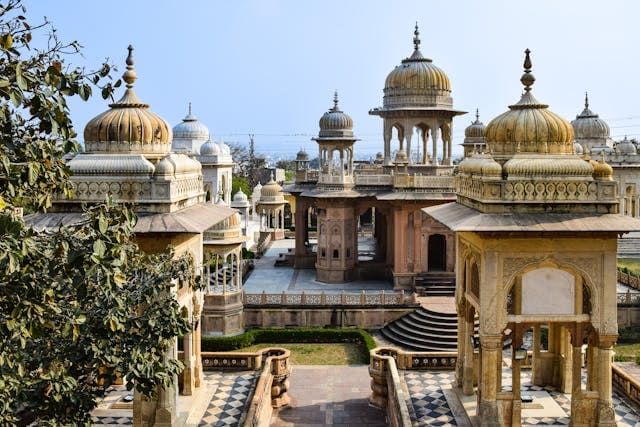
The Chhatris, or cenotaphs, are memorials to the rulers of the Bundelas and are laid out in a row along the beautiful banks of the Betwa River. The monuments still speak of the ancient rulers, their victories, and their stories. These Chhatris are best viewed from the narrow road bridge or from the boulders, from where one gets a perfect reflection of the Chhatris on the still waters of the river.
Overnight stay at the hotel in Orchha.
After breakfast, drive further to Agra.
AGRA - The city of the inimitable Taj Mahal.
The architectural splendor of the mausoleums, the fort, and the palaces is a vivid reminder of the opulence of the legendary Mughal Empire. While its significance as a political center ended with the transfer of the capital to Delhi in 1634 by Shah Jahan, its architectural wealth has secured its place on the international map. A pleasant town with a comparatively slow pace, Agra is known for its superb inlay work on marble and soapstone by craftsmen who are descendants of those who worked under the Mughals.
On arrival in Agra, check-in and rest. Later, visit the following:
Agra Fort
The great Mughal Emperor Akbar commissioned the construction of the Agra Fort, although additions were made until the time of his grandson Shah Jahan. The forbidding exteriors of this fort hide an inner paradise. There are a number of exquisite buildings like Moti Masjid (a white marble mosque akin to a perfect pearl), Diwan-I-Am, Diwan-I-Khaas, Musamman Burj (where Shah Jahan died in 1666 A.D.), Jahangir's Palace, Khaas Mahal, and Shish Mahal. The massive Agra fort is 2.5 km long and is considered the predecessor of the Delhi Red Fort.
Itimad-ud-Daulah
Sometimes called the ‘Baby Taj’ because of its resemblance to Agra’s most famous monument. However, Itimad-ud-Daulah’s Tomb was built before the Taj Mahal. A number of its stylistic features, such as a tomb in white marble surrounded by a formal garden and the use of inlay work in the marble to create floral or geometric designs, inspired similar features of the Taj Mahal.
Mehtab Bagh
Mehtab Bagh is a garden complex located just on the opposite side of the Yamuna River. It is one of the best places in Agra to enjoy the sunset with the rear view of the Taj Mahal.
Overnight stay at the hotel in Agra.
Visit the Taj Mahal as the first thing this morning.
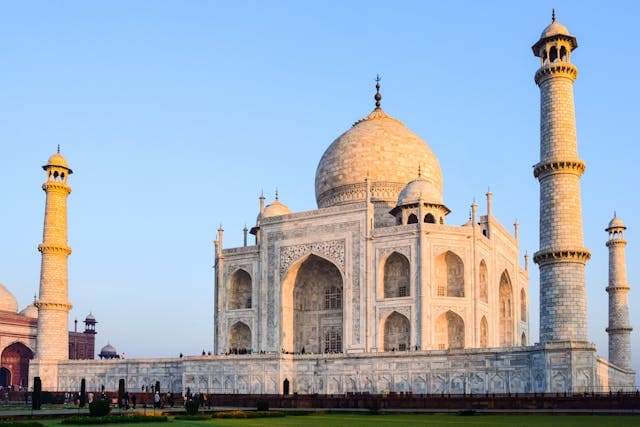
Taj Mahal
The Taj Mahal, or Crown of Palaces, is a white marble mausoleum built by Mughal Emperor Shah Jahan as a memorial to his beloved wife Mumtaz Mahal. A world-renowned wonder, the Taj Mahal looks the same from all four sides and is widely recognized as "the jewel of Muslim art in India and one of the universally admired masterpieces of the world's heritage." The Taj Mahal is phenomenal not only for its beauty but also for the deep planning and design that went into its making. This enchanting mausoleum started in 1631 and took 22 years to complete with the help of an estimated 20,000 workers. (It remains closed on Fridays).
Later, drive further to Jaipur, en route visit Abhaneri.
Abhaneri
On the way to Jaipur, visit the village of Abhaneri. Abhaneri is a small village with a population of approximately 2,000 people. The village is known for Chand Baori Stepwell, which was very important in the past for collecting rainwater. Chand Baori is the largest stepwell in India.
Later, proceed to Jaipur.
JAIPUR - The fascinating capital of the marvelous state of Rajasthan. Jaipur is popularly known as the Pink City, thanks to the color of its buildings. It was built in 1727 A.D by Maharaja Sawai Jai Singh II, following a grid system, making it the only planned city of its time. A young Bengali architect, Vidhyadhar Bhattacharya, designed the city in accordance with Shilpa Shastra, an ancient Hindu treatise on architecture. Jaipur is rich in culture, traditions, and valour, and it’s a royal treat for tourists from all over the world.
On arrival in Jaipur, transfer to the hotel.
Overnight stay at the hotel in Jaipur.
After breakfast, enjoy a city tour in Jaipur including the following:
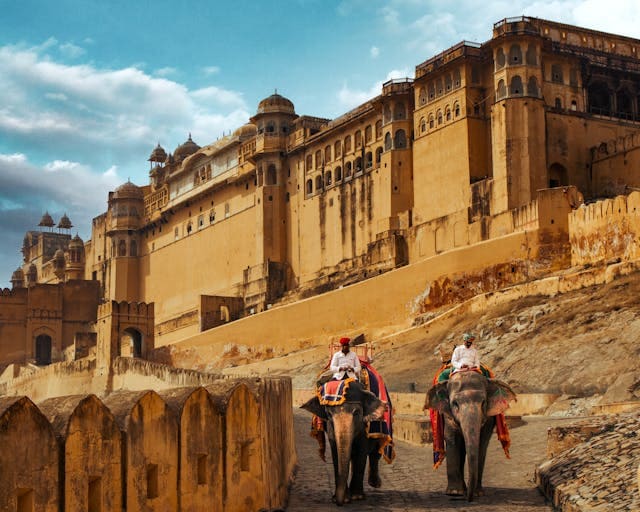
Amber Fort
The Amber Fort, set amidst picturesque and rugged hills, is a stunning blend of Hindu and Mughal architecture. Constructed by Raja Man Singh I in 1592 and later completed by Mirza Raja Jai Singh, the fort is made of red sandstone and white marble. Amber is a classic and romantic fort-palace with a magnificent aura. The interior walls of the palace are adorned with expressive paintings, carvings, precious stones, and mirror work. Built as a secure retreat to defend against enemies, the fort’s heavily structured walls provided protection for its residents.
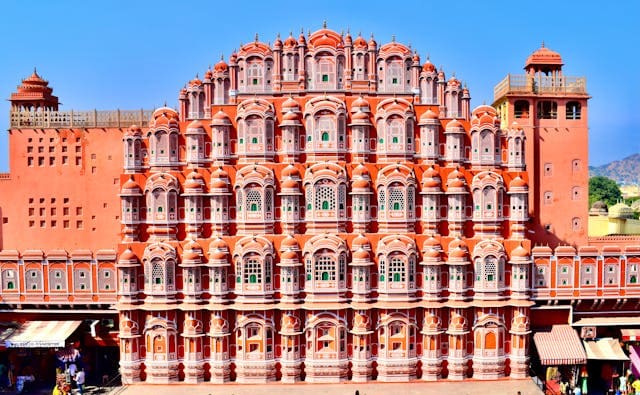
Photo Stop at Hawa Mahal Palace
The Hawa Mahal, or Palace of Winds, was built by Sawai Pratap Singh, the poet king. This iconic five-story building overlooks the busy bazaar street and is a remarkable example of Rajput architecture and artistry. The 953 honeycombed windows, or jharokhas, were originally designed for the royal women to observe the everyday life and processions in the city while remaining veiled and secluded.
City Palace
Located in the heart of the walled city, the City Palace complex reflects the foresight of its founder, Maharaja Sawai Jai Singh II. It showcases some of the most imposing and magnificent architecture in the city. A blend of Mughal and Rajput architecture, the palace is still home to the ex-royal family who resides in a part of the palace.
Jantar Mantar
Jantar Mantar is an impressive collection of architectural astronomical instruments built by Maharaja Jai Singh II between 1727 and 1734. Modeled after the one he had built in Delhi, this observatory is the largest and best-preserved of its kind. The Jaipur Jantar Mantar is listed as a World Heritage Site and stands as an expression of the astronomical skills and cosmological concepts of the late Mughal period.
In the afternoon, explore the local markets of Jaipur.
Optional Activity:
Elephant Bathing, Feeding, and Painting with BBQ Dinner at Dera Amer (90 USD per person, drinks extra)
Experience a unique interaction with elephants at Dera Amer. This special activity allows you to feed, bathe, and paint these gentle creatures using organic colors. The elephants are all female, making them affectionate and calm, ensuring a safe and enjoyable experience. Enjoy a BBQ dinner in this enchanting setting.
Overnight stay at the hotel in Jaipur.
Today is a day at leisure in the Pink City, Jaipur.
Take this opportunity to immerse yourself in the vibrant pulse of the city. Wander through its colorful streets, where the rich history blends effortlessly with the modern energy of local life. You might find yourself captivated by the intricate crafts and textiles, or perhaps you'll enjoy a leisurely stroll through the serene corners of the city, taking in the sights and sounds that make Jaipur so unique.
Indulge in the flavors of the region at your own pace, exploring the local cuisine or simply relaxing in the atmosphere of the city. Whether you choose to unwind or explore, today is yours to savor.
Overnight stay at the hotel in Jaipur.
After breakfast, drive to Deogarh.
Nestled at an altitude of about 2100 feet above sea level, Deogarh offers a cooler, more tranquil escape compared to other parts of Rajasthan. The town is home to Deogarh Mahal, a stunning palace founded in 1670 AD by Rawal Dwarka Das Ji as a family residence. This palace has served as a cultural hub, showcasing the rich history and traditions of the Mewar region. Deogarh Mahal stands as a testament to India’s heritage, with its vibrant colors, detailed furnishings, and intricate art that highlight the grandeur and beauty of the region.
In the evening, enjoy a leisurely stroll through the local bazaar, where the sights, sounds, and aromas of the town will give you a taste of authentic Rajasthani life.
Overnight stay at the Deogarh Mahal in Deogarh.
After breakfast, drive further to Udaipur.
Often referred to as the “City of Lakes,” Udaipur was founded in 1559 AD by Maharana Udai Singh as the capital of the former Mewar state. Nestled on the eastern banks of Lake Pichola, Udaipur is known for its rich cultural, social, and natural heritage. The serene lakes, the opulent hilly range of the Aravalis, lush green vegetation, and the beautiful gardens all contribute to its scenic charm. The city is a mesmerizing blend of architecture, history, and nature, with Lake Pichola continuing to allure visitors with its magical beauty.
On arrival, check in at the Hotel. Rest of the day is at leisure.
Overnight stay at the hotel in Udaipur.
Optional: Cycling Tour at Sunrise (60 USD per person)
Highlights:
Cycle through the vibrant streets and serene countryside of Udaipur
Enjoy a delicious breakfast amidst scenic views
Personal guide to enhance your experience
All necessary equipment, hotel pick-up, and drop-off included
What to Expect:
Start your day early with a pickup from your hotel at 06:30 AM. The tour begins with a briefing on safety precautions and other instructions before setting off at 07:30 AM. Cycle through the historic old city of Udaipur, passing small villages, picturesque landscapes, and the calmness of dawn. Pedal through easy, mostly level terrain, with some moderate hills for an exciting challenge. Enjoy a rest stop by the shimmering lakeside, where you can take in the views and enjoy your packed breakfast. The ride covers 20 km and ends at 09:30 AM.
Inclusions:
Hotel pick-up and drop-off
Use of bicycle and helmet
Local guide
Packed breakfast
Additional Info:
Not recommended for participants with back problems or heart conditions.
After breakfast, proceed for a visit to Udaipur, starting with:
City Palace
Standing tall by the shores of Lake Pichola, the City Palace is an architectural marvel. Initiated by Maharana Udai Singh and expanded by successive rulers, the palace complex offers remarkable uniformity in design. Enter through the Elephant Gate (Hathi Pol) and proceed through the Tripolia Gate. The intricate balconies, towers, and cupolas of the palace offer breathtaking views of the lake.
Jagdish Temple
One of Udaipur's most iconic temples, Jagdish Temple is dedicated to Lord Vishnu. Built in 1651 by Maharana Jagat Singh, this Indo-Aryan style temple is celebrated for its stunning architecture and intricate carvings. It is the largest temple in Udaipur, located just 150 meters from the City Palace.
Sahelion Ki Bari
This exquisite garden, built in the mid-18th century, reflects the lifestyle and impeccable taste of the royal women of the court. With its four pools, fountains, flowerbeds, and lotus pools, Sahelion Ki Bari creates a peaceful oasis. The fountains function purely on water pressure, making it a marvel of hydraulic engineering.
Boat Ride on Lake Pichola
Experience the tranquil beauty of Lake Pichola with a boat ride in the evening. Surrounded by hills, gardens, and temples, the lake offers some of the best views of Udaipur. The boat ride is the perfect way to appreciate the historical monuments dotting the lakeside, with a unique perspective from the water.
Sunset at Karni Mata Temple
For a serene and spiritual experience, head to Karni Mata Temple, perched atop a hill. From here, you can enjoy stunning panoramic views of the city as the sun sets behind the Aravalli hills. The peaceful ambiance and beautiful surroundings make this a memorable moment.
Overnight stay at the hotel in Udaipur.
On time transfer to Udaipur Airport for your flight to Delhi. Upon arrival in Delhi, you will be transferred to a hotel nearby the airport, where you will have a room to relax for a few hours before your departure.
Enjoy a comfortable stay and a farewell dinner at the hotel, reflecting on the memorable experiences of your journey. Later, at the appropriate time, you will be transferred to Delhi International Airport to board your flight back home.
End of the journey, filled with lasting memories of your travels. Safe travels, and we hope to welcome you again soon!
Services included:
Services of accompanying Tour Guide from arrival till departure
All ground transportation as detailed in the itinerary using air-conditioned vehicle
Double/twin room with breakfast
Monument entrance fee mentioned in the tour itinerary
Domestic airfare: Delhi – Varanasi
Domestic airfare: Udaipur – Delhi
Heritage Walk in Old Delhi
Boat ride in Varanasi
Jeep ride at Amber Fort in Jaipur
Boat tour in Udaipur
Airport transfer in Udaipur
Freshen Up Room on the last day in New Delhi with dinner
Airport transfer in Delhi for the flight to the home country
Water bottles during the tour
Currently applicable taxes
Not included services:
Visa application process and fees
International airfares and taxes
Camera and video charges at the monuments where applicable
Any expenditure of a personal nature such as drinks, tips, laundry, telephone charges, etc.
Insurances (travel cancellation insurance, health insurance, etc.)
Any new tax imposed by the government
Any chosen optional activity/program
GALLERY / PHOTOS


MORE PACKAGES
OTHER TRAVEL PACKAGES
Frequently Asked Questions – 18 Day North India Heritage Tour
1. What is included in a 2-week Holi festival tour in India?
This 14-day India itinerary includes Delhi, Varanasi, Khajuraho, Orchha, Agra, Jaipur, Deogarh and Udaipur. It combines the Golden Triangle with spiritual destinations, heritage towns, and the celebration of the Holi festival in India.
2. What is the Holi festival in India and why is it special?
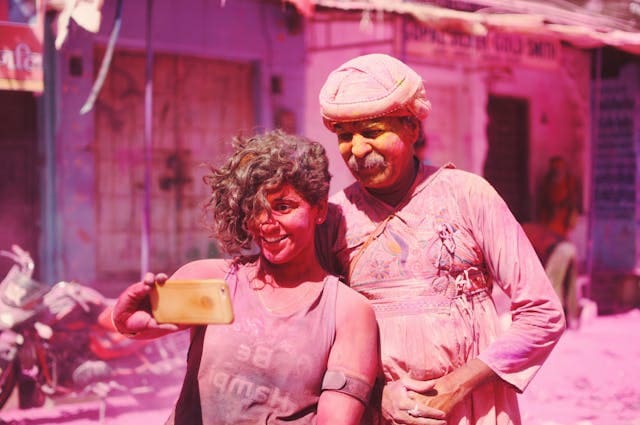
Holi is one of India’s most vibrant festivals, celebrating the arrival of spring and the victory of good over evil. Known as the “Festival of Colors,” it involves music, dancing and the playful use of colored powders.
3. Is it safe for international travelers to celebrate Holi in India?
Yes, when organized properly, Holi can be a safe and enjoyable experience. This tour ensures that celebrations take place at one of the most authentic and famous place in Jaipur where some local people also gather to celebrate the festival.
4. Is 2 weeks enough for an India itinerary including Holi?
Yes, 2 weeks is an ideal duration to explore North India while experiencing Holi. This itinerary balances major highlights with unique destinations and cultural experiences without feeling rushed.
5. What are the highlights of this Holi tour in India?
- Celebrating Holi Festival in Jaipur
- Spiritual rituals along the Ganges in Varanasi
- Temples of Khajuraho (UNESCO World Heritage Site)
- Heritage town of Orchha
- Taj Mahal in Agra
- Royal Rajasthan (Jaipur, Deogarh, Udaipur)
- Cultural experiences and local interactions
6. What is special about Khajuraho and Orchha?
Khajuraho is famous for its intricately carved temples, recognized as a UNESCO World Heritage Site. Orchha, on the other hand, is a quiet heritage town known for its palaces, temples and historical charm, offering a peaceful contrast to larger cities.
7. What type of accommodation is included in this Holi tour?
The tour includes a mix of boutique hotels, heritage properties and premium accommodations. Many heritage hotels are restored palaces or mansions that offer a unique cultural stay experience.
8. What are heritage hotels in India?
Heritage hotels are historic buildings such as palaces, forts or noble residences that have been converted into hotels. They allow guests to experience India’s royal history and traditional architecture while enjoying modern comforts.
9. What is the best time to travel for the Holi festival in India?
Holi usually takes place in February or March, depending on the lunar calendar. This period is also one of the best times to visit North India due to pleasant weather.
10. How do you travel between destinations on this tour?
Travel is arranged through a combination of private air-conditioned vehicles, trains or domestic flights (depending on the route), ensuring comfort and efficiency.
11. Is this India tour suitable for first-time visitors?
Yes, this itinerary is ideal for first-time travelers as it includes iconic landmarks along with deeper cultural and spiritual experiences.
12. What should I wear during the Holi festival?
It is recommended to wear comfortable, White-colored clothes that you don’t mind getting stained, as Holi involves colored powders and water.
13. Do I need a visa to travel to India for this tour?
Yes, most travelers require an Indian e-visa, which can be easily applied for online before travel.
14. Why combine the Golden Triangle with Varanasi and Rajasthan?
This combination offers a complete India experience—historic landmarks, spiritual depth, royal heritage and cultural diversity—all within a well-balanced 2-week itinerary.
15. What makes this Holi tour different from standard India tours?
This itinerary goes beyond typical routes by combining the Holi festival with spiritual destinations like Varanasi and heritage experiences in Rajasthan. It focuses on meaningful travel, curated experiences and a balanced pace.
Why Choose This Holi Festival Tour
Holi in India is more than just a celebration—it is an experience of color, culture and connection.
This journey is designed to let you experience it in a way that feels authentic, comfortable and meaningful.
Unlike standard tours, this itinerary carefully combines the energy of the Holi festival with the depth of India’s cultural and spiritual heritage. From the timeless rituals of Varanasi to the architectural beauty of Khajuraho and the royal charm of Rajasthan, each destination adds a unique layer to your journey.
What makes this tour truly special is the balance it offers.
You don’t just witness India—you experience it at the right pace, with space to absorb its contrasts, traditions and everyday life.
The Holi celebration itself is thoughtfully curated, allowing you to participate in a safe and welcoming environment—where you can enjoy the festival with locals, without feeling overwhelmed.
Along the way, carefully selected accommodations, including heritage properties, add character and comfort to your stay—turning each night into part of the experience.
This is not just a festival tour.
It is a journey through India’s colors—both seen and felt.
Plan Your Dream Holi Festival Tour
Your royal journey starts here. Explore majestic palaces, golden deserts, and India’s most celebrated landmarks with our tailored rajasthan tour and travel packages.